Read Journals 1759 – Vol 67 No 2 – Prediction of the fundamental period of infilled reinforced concrete frame structures using advanced machine learning methods
CPD NO: SAICE/OJ/25/67/2/26/28
0.2 ECSA CPD points allocated
Course Content
Read Journals 1759 – Vol 67 No 2 – Prediction of the fundamental period of infilled reinforced concrete frame structures using advanced machine learning methods (Pdf of Article)
You don't currently have access to this content
Read Journals 1759 – Vol 67 No 2 – Prediction of the fundamental period of infilled reinforced concrete frame structures using advanced machine learning methods (Final Assessment)
You don't currently have access to this content
Read Journals 1759 – Vol 67 No 2 – Prediction of the fundamental period of infilled reinforced concrete frame structures using advanced machine learning methods (Final MCQ Assessment)
You don't currently have access to this content
Author
Current Status
Not Enrolled
Enroll in this course to get access
Price
ZAR 370.00
Get Started
discounted for SAICE members
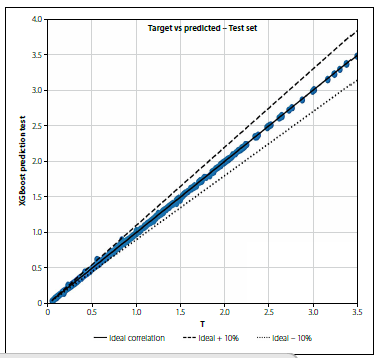
The use of machine learning (ML) to solve civil engineering problems has increased remarkably during the last few decades due to its effectiveness in reliably approximating complex relationships. In this paper, a key parameter of seismic design is estimated using hyperparameter ML algorithms to develop predictive models that compute the fundamental period. Initially, the impact of the train-test split ratio was investigated using three different splits, where the best results were achieved with train-test split ratios equal to 90/10 for all metrics. By predicting the fundamental period with three ML methods, namely XGBoost-HYTCV, DANN-MPIH-HYT, and RF-HYT, the best fit was acquired by XGBoost-HYT-CV (coefficient of
determination R2 = 99.994% and mean absolute error MAE = 0.00428). Although international literature agrees that building height is the primary factor influencing the fundamental period, feature engineering has revealed that the natural logarithm of the percentage of openings is the most significant parameter. This finding underscores the value of feature engineering in generating additional variables and uncovering their impact on output variables. Finally, an equation was derived from POLYREG-HYT that outperformed all existing formulae, deriving a final MAE of 0.0153, approximately three times smaller than the best-performing equations proposed in the international literature.
Keywords: fundamental period, tuned hyperparameters, feature importance, machine learning, reinforced concrete structures, numerical modelling