Read Journal 1376 Volume 58 No 4 – The effect of type, concentration and volume of dispersing agent on the magnitude of the clay content determined by the hydrometer analysis
CPD NO: SAICE/OJ/2026/58/4/48/2029
0.2 ECSA CPD points allocated
Course Content
Read Journal 1376 Volume 58 No 4 – The effect of type, concentration and volume of dispersing agent on the magnitude of the clay content determined by the hydrometer analysis (Journal Article)
You don't currently have access to this content
Read Journal 1376 Volume 58 No 4 – The effect of type, concentration and volume of dispersing agent on the magnitude of the clay content determined by the hydrometer analysis (MCQ Assessment)
You don't currently have access to this content
Author
Current Status
Not Enrolled
Enroll in this course to get access
Price
ZAR 370.00
Get Started
discounted for SAICE members
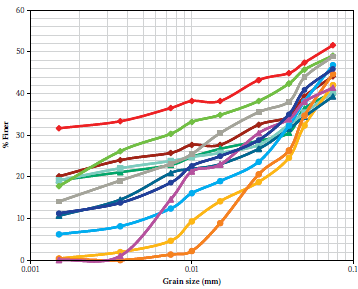
Knowledge of the physical properties of soils, including the clay content, is of utmost importance in the field of geotechnical engineering. The hydrometer analysis is the most widely used technique for the analysis of the particle size distribution of the fine-grained fraction of a soil, calculated using sedimentation principles. The hydrometer analysis utilises a dispersing agent – Calgon 33:7 (comprising 33 grams of sodium hexametaphosphate and 7 grams of sodium carbonate when mixed in 1 litre of water) is universally considered as the most effective dispersing agent. In this investigation, hydrometer analyses were conducted (according to the TMH1 1986 method) on two soils (alluvium and black clay), using five dispersing agents. The results show that the clay size fraction can vary significantly (from 1% to 32%) for the two soils, depending upon the dispersing agent used. From these initial results, the two most effective dispersing agents (Calgon and sodium pyrophosphate decahydrate – NaPP) were investigated further to establish the optimum concentration and volume. Calgon proved to be the most effective in the alluvial soil, increasing the clay content by 38%. The NaPP was most effective in the relatively active black soil, increasing the clay content by 25%.