Read Journals 1906 – Vol 68 No 2 – Optimising traffic flow at major intersections in East London’s CBD using quantum flow theory: A case study of Oxford Street
CPD NO: SAICE/OJ/26/68/2/45/2029
0.2 ECSA CPD points allocated
Course Content
Read Journals 1906 – Vol 68 No 2 – Optimising traffic flow at major intersections in East London’s CBD using quantum flow theory: A case study of Oxford Street (Journal Article)
You don't currently have access to this content
Read Journals 1906 – Vol 68 No 2 – Optimising traffic flow at major intersections in East London’s CBD using quantum flow theory: A case study of Oxford Street (Final Assessment)
You don't currently have access to this content
Read Journals 1906 – Vol 68 No 2 – Optimising traffic flow at major intersections in East London’s CBD using quantum flow theory: A case study of Oxford Street (MCQ Assessment)
You don't currently have access to this content
Author
Current Status
Not Enrolled
Enroll in this course to get access
Price
ZAR 370.00
Get Started
discounted for SAICE members
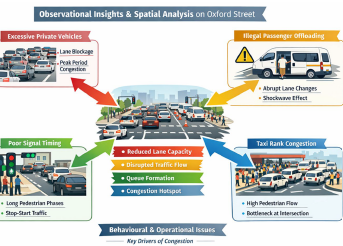
Urban traffic congestion continues to challenge sustainable mobility in South African cities, particularly in central business districts (CBDs) where travel demand often exceeds network capacity. Oxford Street in East London’s CBD experiences persistent congestion caused by high vehicle volumes, unsafe driving behaviour, limited parking, and ineffective traffic control. This study investigates Quantum Flow Theory (QFT) as an analytical framework for improving traffic flow by modelling traffic as a probabilistic, multi-agent system rather than a deterministic stream. A quantitative research design was employed, combining structured questionnaires administered to 384 road users with field observations and historical traffic data. Peak congestion occurred during the morning (06:00 to 10:00) and afternoon (14:00 to 18:00) periods, with over 90% of respondents reporting heavy traffic. Correlation and multinomial logistic regression analyses revealed significant associations between congestion, illegal passenger loading, and on-street parking activity. Applying QFT principles to intersection performance
showed that adaptive signal timing informed by probabilistic traffic states could improve congestion-prediction accuracy by approximately 18% compared to static traffic models. The findings support targeted interventions including signal optimisation, parking management, and demand-reduction strategies such as carpooling and improved public transport.