Read Journal 1366 Volume 59 No 1 – Numerical modelling of flexible pavement incorporating cross-anisotropic material properties Part I: Surface circular loading
CPD NO: SAICE/OJ/2026/59/1/22/2029
0.2 ECSA CPD points allocated
Course Content
Read Journal 1366 Volume 59 No 1 – Numerical modelling of flexible pavement incorporating cross-anisotropic material properties Part I: Surface circular loading (Journal Article)
You don't currently have access to this content
Read Journal 1366 Volume 59 No 1 – Numerical modelling of flexible pavement incorporating cross-anisotropic material properties Part I: Surface circular loading (Final Assessment)
You don't currently have access to this content
Read Journal 1366 Volume 59 No 1 – Numerical modelling of flexible pavement incorporating cross-anisotropic material properties Part I: Surface circular loading (MCQ Assessment)
You don't currently have access to this content
Author
Current Status
Not Enrolled
Enroll in this course to get access
Price
ZAR 370.00
Get Started
discounted for SAICE members
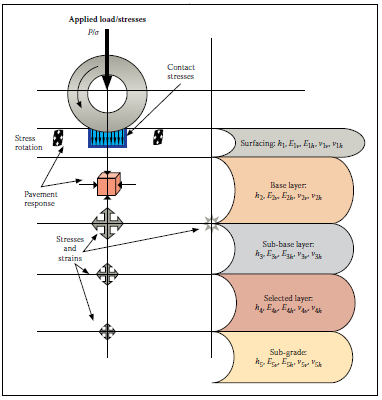
Accurate numerical modelling of the behaviour of road pavement layers is an important requirement for the design and evaluation of road pavements. This modelling includes the prediction of pavement performance under the action of traffic loading and environmental factors. Depending on the complexity of the models, properties of pavement layers that may be considered are wide-ranging – from linear or nonlinear elastic to cross-anisotropic through to linear visco-elasto-plastic. Some properties, such as cross-anisotropic, are not only related to placement and compaction of the pavement layers, but are also inherent to the materials used. Other properties, such as linear visco-elasto-plastic, are specific to asphalt concrete and depend on the speed and magnitude of traffic loading, as well as the environment (temperature) in which the road is located. This paper presents basic theoretical derivation of numerical modelling of a flexible pavement considering cross-anisotropic material properties (with isotropic properties as a special case). The solutions derived in this paper are based on Hankel transformation of Navier’s equations. The accuracy and validity of the solutions are verified through comparisons with a proprietary finite element method (FEM) package. For this purpose, a pavement structure composed of five main layers constituted by isotropic and cross-anisotropic (also known as transversely isotropic) material properties is analysed. In order to vary some of the layer properties with depth, the main layers were sub-layered, resulting in a 17-layer pavement system.