Read Journals 1758 – Vol 67 No 3 – Physical model study of novel deflector forms on uncontrolled spillways
CPD NO: SAICE/OJ/26/67/3/2/29
0.2 ECSA CPD points allocated
Course Content
Read Journals 1758 – Vol 67 No 3 – Physical model study of novel deflector forms on uncontrolled spillways (Journal Article)
You don't currently have access to this content
Read Journals 1758 – Vol 67 No 3 – Physical model study of novel deflector forms on uncontrolled spillways (Final Assessment)
You don't currently have access to this content
Read Journals 1758 – Vol 67 No 3 – Physical model study of novel deflector forms on uncontrolled spillways (MCQ Assessment)
You don't currently have access to this content
Author
Current Status
Not Enrolled
Enroll in this course to get access
Price
ZAR 370.00
Get Started
discounted for SAICE members
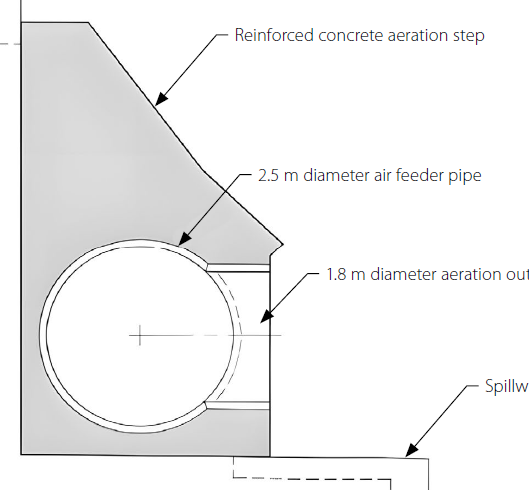
Spillways are designed to control the release of excess water from a reservoir and safely convey it downstream to prevent overtopping and structural failure. The field of stepped spillways hydraulics has seen extensive research, yet several fundamental hydraulic aspects remain inadequately explored. Notably, the elusive safe unit discharge limits for these spillways remain a subject of contention within the existing literature. This paper discusses an investigation into the feasibility of novel deflector forms aimed at increasing the safe discharge capacity of uncontrolled spillways by deflecting the flow away from the spillway slope. A 1:50 scale
physical model was constructed to investigate the influence of different deflector forms. The investigation spans a range of prototype unit discharges ranging from 50 m3/s/m to 200 m3/s/m and evaluates factors such as water surface profiles created by the deflector and pressure distribution on the deflector. The proposed novel deflectors developed in this study proved to be effective at various flow rates when the flow trajectory and threshold pressures were considered. These deflectors could be used for dams higher than 150 m and unit discharges between 100 m3/s/m and 200 m3/s/m.
Keywords: spillways, unit discharge, physical model, pressure, deflector, jet trajectory